
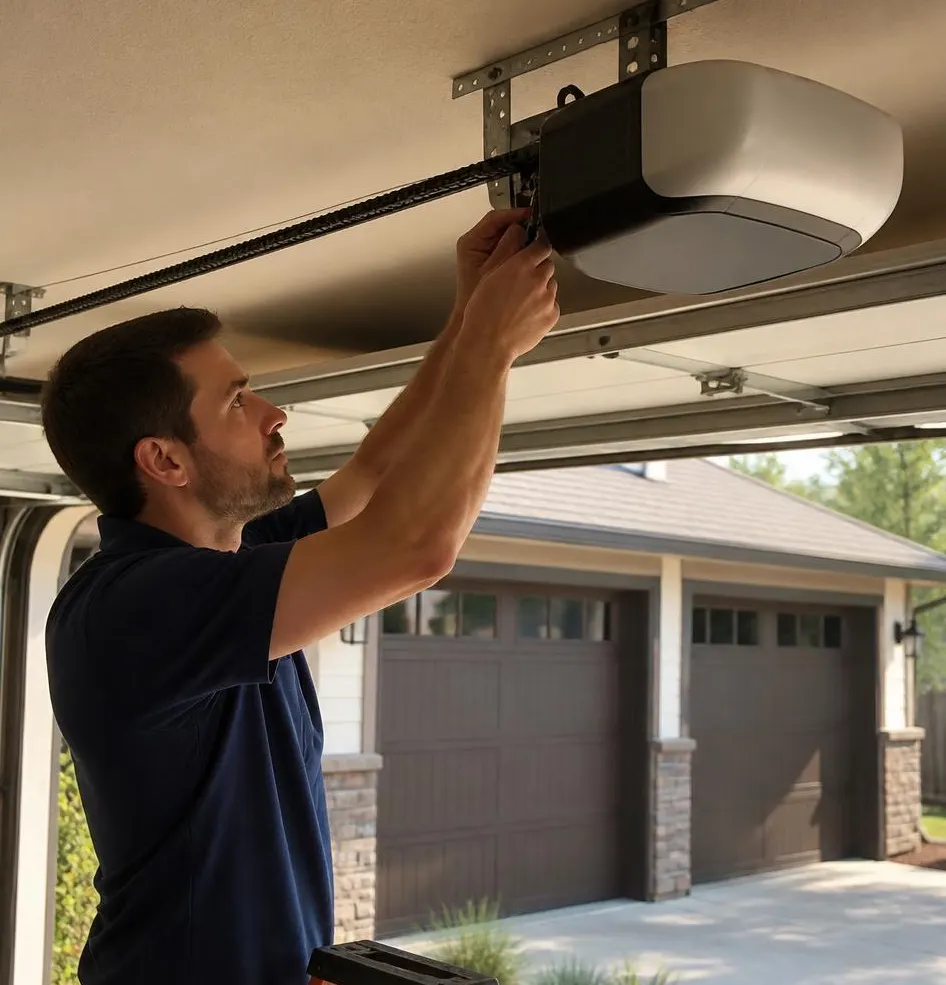
The Mistake Almost Everyone Makes First
You're late, it's fifteen degrees out, and the garage door won't budge. So you hit the remote again. And again. Or you grab the manual release and try to muscle the door up by hand. It's an understandable reflex — the door worked fine last week, so the problem feels like it must be temporary and solvable with a little extra force.
The trouble is, repeated button-mashing just makes the opener motor strain against resistance it can't overcome, which can strip the drive gear or burn out the motor. And if the door is genuinely iced to the slab, forcing it up can bend the bottom panel or tear the weatherstripping clean off. Before you push harder, it helps to know what you're actually looking at.
What It Looks Like When Cold Weather Has Your Door Stuck
- The door won't move at all, whether you use the remote, the wall button, or try it by hand.
- The opener hums or strains, the light blinks, but the door doesn't lift.
- The door rises an inch or two, then the opener reverses it back down.
- The door moves, but noticeably slower than usual, with extra creaking or grinding.
- You can see frost, ice, or a thin glaze where the bottom seal meets the concrete slab.
- One side lifts before the other, leaving the door crooked for a second before it catches.
Each of these points toward a slightly different cause, and a technician works through them in a specific order — starting with the simplest and most common, and moving toward the ones that need real tools and training.
Working Through the Causes, in the Order a Technician Checks Them
1. The bottom seal is frozen to the slab
This is the single most common reason a door won't open on a cold Harrisburg morning. Snowmelt or slush gets under the door during a milder afternoon, then refreezes overnight as temperatures drop — a cycle that repeats constantly through a typical central PA winter. Older homes with original, cracked, or flattened weatherstripping are especially prone to this, since there's less of a barrier between the rubber seal and the ground.
What the fix involves: never pry or force the door. Pour warm (not boiling) water along the seal, or use an ice melt product that's safe for rubber and concrete rather than rock salt, which degrades both. A technician will also check the condition of the bottom astragal seal and replace it if it's thin, torn, or no longer sitting flush — a cheap fix that prevents the problem from repeating all winter.
2. Worn or missing weatherstripping around the frame
If the bottom seal looks fine but the door still feels drafty or sticky, the perimeter weatherstripping along the sides and top is the next check. Gaps here let wind-driven snow and ice work their way into the track area. On older doors, this strip is often original equipment and brittle enough to crack when you touch it. Replacing it is straightforward and usually gets paired with a broader maintenance visit.
3. Lubricant on the rollers, hinges, and tracks has thickened
Standard grease stiffens as temperatures drop, and a roller that moved smoothly in October can suddenly drag in November. This is more noticeable on steel rollers and on doors that haven't been serviced recently, since road salt tracked in from the driveway speeds up grime buildup. The fix is to clean off the old grease and residue, then apply a lithium-based lubricant rated for cold weather. If the rollers are original steel, swapping them for nylon is worth discussing, since nylon handles temperature swings better over time.
4. The springs have lost tension in the cold
Steel contracts slightly as it gets colder, and torsion springs lose a bit of lifting power as a result — more noticeably if the springs are already older and near the end of their cycle life. This often shows up as a door that lifts partway, then stalls or gets reversed by the opener. It's also the most important cause to catch early, because cold-brittle springs are more likely to snap outright, and a failed spring under tension is dangerous to deal with yourself. A technician checks the spring's wear, coil spacing, and rust before recommending a full replacement rather than a patch.
5. Opener force and limit settings are off
If the opener was last calibrated on a warm day, it may not account for the added resistance of stiff rollers or slightly weaker springs, and will reverse the door before it finishes opening. This is adjustable — a technician resets the open and close force and limit settings, then rebalances the door so the opener isn't doing more work than it should.
6. Track alignment, as a last check
If the door only binds on one side or catches partway through its travel, a misaligned or salt-corroded track is checked last, since it's less common than the issues above but still shows up more on older housing stock after a few winters of plowing and road spray.
When to Call Harrisburg Garage Door
If your door has frozen to the slab more than once this season, if the opener is straining or reversing, or if you can see rust or gaps in the spring coils, it's time to call rather than keep working around it. A Garage Door Opener Service visit covers the lubrication, force settings, and roller inspection in one trip, while Spring Replacement is handled with the right tools and tension equipment so nothing lets go unexpectedly. A Preventive Maintenance check before the deepest part of winter sets in can catch most of these issues before they turn into a morning where the door simply won't move at all.
If your garage door is sticking, groaning, or freezing shut this season, Harrisburg Garage Door services homes and businesses throughout Harrisburg, Mechanicsburg, Camp Hill, Lemoyne, Enola, Hershey, Carlisle, and Middletown. Give us a call and we'll get it moving smoothly again before the next cold snap.