
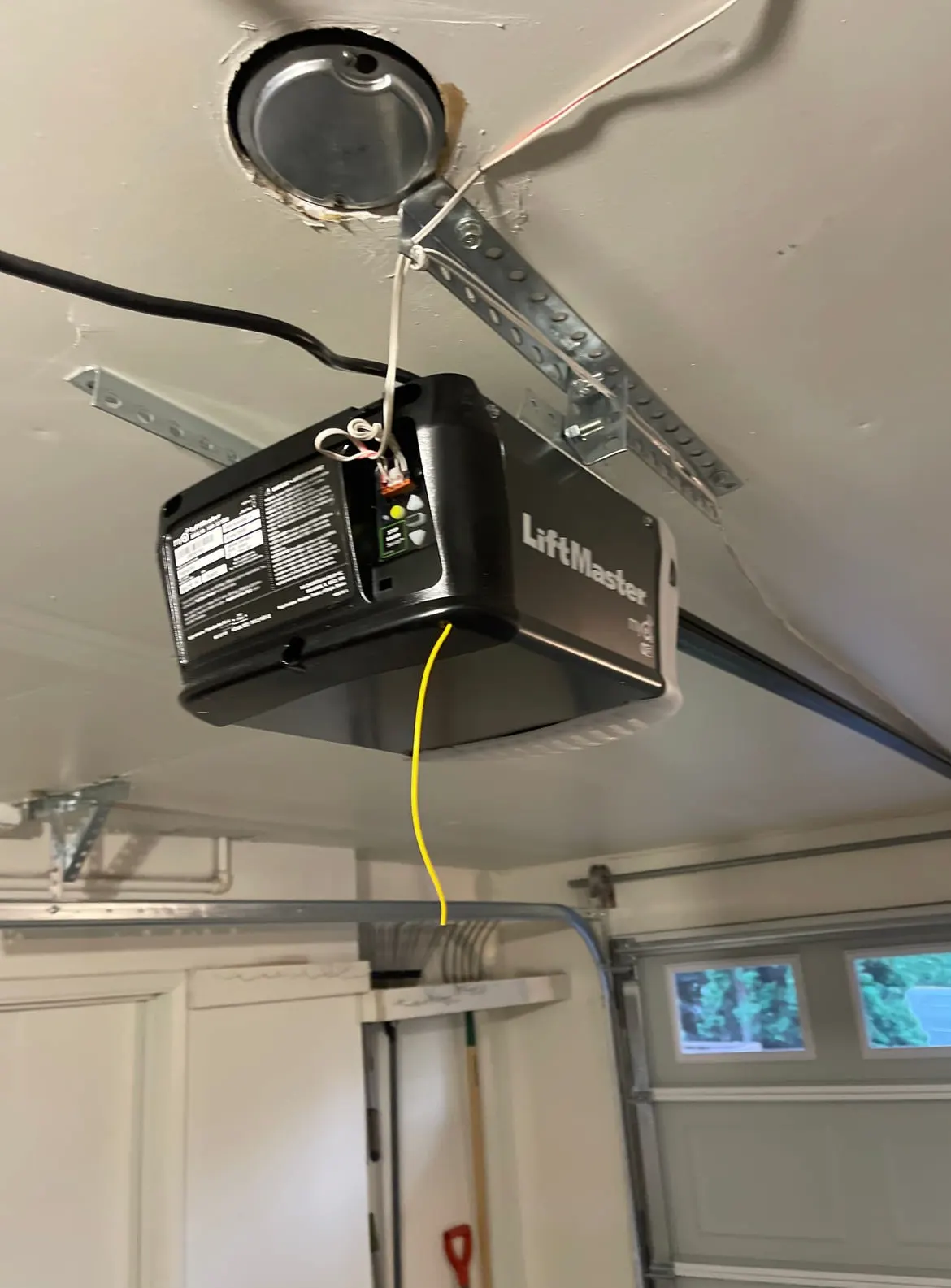
Here's what ignoring this costs you: a nor'easter knocks out power at 11pm, the temperature's dropping fast, and your car is stuck in a garage that won't open because the opener has no juice and the manual release cord is frozen stiff or hard to reach in the dark. Multiply that by every ice storm and wind event that rolls through central PA each winter, and "we'll deal with it later" starts looking expensive. This is the conversation worth having now, not during the next outage.
What a battery backup actually does
A battery backup is a small battery pack built into (or added onto) your garage door opener unit. When the power cuts out, it automatically kicks in and runs the opener motor off stored battery power instead of your home's electricity. You press the remote or the wall button like normal, and the door opens and closes as if nothing happened. No manual pulling, no fumbling with a release cord, no standing in the driveway in freezing rain trying to lift a door by hand.
It's not a whole-house generator and it won't power your lights or furnace. It exists for one job: keep the garage door operational during a power outage, for a limited number of cycles, until the power comes back or the battery runs down.
How it works, mechanically
- Normal operation: the opener runs on standard household current, and the battery sits fully charged, doing nothing.
- Power loss: a sensor in the unit detects the outage and switches the opener over to the battery automatically — you don't flip anything.
- Backup operation: the opener runs the door open and closed a set number of times (many units are rated for roughly 10–20 cycles) before the battery depletes.
- Power restored: the unit switches back to household current and starts recharging the battery for next time.
Is it required, or just nice to have?
This is where the spouse argument usually lives, and the honest answer is: it depends on what opener you have.
- Newer openers (most sold in recent years): many current models from major manufacturers include battery backup as a standard feature, largely in response to industry safety standards for entrapment protection. If you've bought a new opener in the last several years, there's a decent chance you already have one and don't realize it.
- Older openers: if your opener predates that shift, it almost certainly has no battery backup at all, and none is coming unless you add one or replace the unit.
- Retrofitting: some manufacturers sell add-on battery backup units compatible with specific opener models, but it only works if your current opener supports it — it's not universal.
So the real question isn't "is it required by some rule," it's "do I have one, and if not, how exposed am I when the power goes out?" For a lot of the older housing stock around here with original garage doors and openers that have quietly run for fifteen-plus years, the honest answer is: no backup, no plan.
Why this matters more here than in milder climates
Battery backup is useful everywhere, but it earns its keep in this region specifically because of how outages tend to happen. Ice accumulation on power lines during a freeze-thaw cycle, heavy wet snow from a nor'easter, or summer storm downbursts all tend to knock out power at inconvenient moments — often right when you need to get a car out for work, get home before a storm worsens, or close the garage against wind-driven snow. Add in a door that's already stiff from cold-weather binding or an original garage door that doesn't move easily by hand, and a power outage turns a minor inconvenience into a genuine hassle, sometimes at night, sometimes in bad weather.
The trade-offs, honestly
- Cost: openers with built-in battery backup typically run somewhat more than otherwise-comparable models without it, often in the range of an extra $50–$150 depending on brand and features — a rough national range, not a quote.
- Battery life: the backup battery itself usually needs replacing every few years, similar to a smoke detector battery but larger and specific to the opener.
- It's not infinite power: it's designed for a handful of cycles during an outage, not for running the door all week if the power stays off for days.
- Peace of mind: for a lot of households, being able to get the car out without yanking a frozen release cord in the dark is worth the modest upfront cost on its own.
The verdict, for the argument
If your opener already has battery backup, you're set — just make sure the battery itself is still holding a charge (most units show a light or run a self-test). If it doesn't, and you're using the manual release as your actual backup plan during outages, that's a workable short-term fallback, but it's also exactly the kind of thing that stops being workable the moment the release cord is frozen, hard to reach, or the door is too stiff to lift by hand — which is common on original doors once winter sets in.
When to call Harrisburg Garage Door
If you're not sure whether your current opener supports battery backup, or you want one added before the next deep freeze, that's a quick diagnostic for our Garage Door Opener Service — we can tell you what you have and what your options are. And if your opener is old enough that a retrofit isn't realistic, it's often part of a broader conversation about Garage Door Installation, since a new opener with backup built in is usually simpler and more reliable than patching an aging one.
Settle the argument before the next storm, not during it. Call Harrisburg Garage Door and we'll get your opener ready for whatever this winter sends toward Harrisburg, PA and the surrounding area.